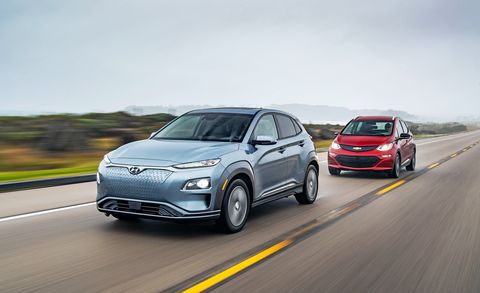
Tesla didn't draw in almost a large portion of a million bookings for the Model 3 since electric vehicles are faltering. A remarkable opposite: Instant torque, one-pedal driving, and negligible running costs mean EVs should engage even vigorous enthusiasts of inward ignition. However Tesla hasn't shut a noteworthy number of those deals, with many would-be purchasers probably reluctant or powerless to burn through $45,000 or more for the Model 3 as it is as of now advertised. With no indication of the guaranteed $35,000 form and Tesla's government charge credit slowing down, maybe it's a great opportunity to think about different alternatives.
You won't get Tesla's extravagance cachet in the options, which originate from mass-showcase carmakers, ones that move on cost. You won't get much decision, either. As of now there are only two EVs that sticker underneath $40,000 and brag battery packs sufficiently huge to permit driving more than 200 miles on a charge, despite the fact that a third will go marked down soon. The Hyundai Kona Electric arrived before the actual arranged time this year and, nearby its gas-fueled variations, made our 2019 10Best Trucks and SUVs list. Its beginning cost of $37,495 matches the Chevrolet Bolt EV's, which was a 10Best vehicle in 2017 preceding it had any challenge. Nissan's Leaf Plus will go at a bargain in the blink of an eye, with an all the more dominant, 215-hp electric engine and a bigger, 62.0-kWh battery pack than the standard Leaf conveys, enabling it to extend its range another 76 miles, to 226. Sadly, Nissan declared the new model as we were leading this test.
Vehicle and DriverJessica Lynn Walker
The Bolt has changed little since its presentation for the 2017 model year. It matches a 200-hp engine with a 60.0-kWh lithium-particle battery pack to convey an EPA-appraised 238 miles of range. Our test vehicle was a top notch Premier, which begins at $41,895, a cost expanded by additional chrome, fancier wheels, and warmed cowhide front and back detachable seats, among different amenities. Discretionary hardware—including the critical $750 DC-quick charging alternative, some dynamic security tech, and updated infotainment—included $2125, conveying the expense to a nearly Tesla-like $44,130. What's more, in spite of the fact that you can even now purchase a Bolt and get the most extreme $7500 government charge credit for buying another EV, that sum gets cut down the middle beginning April 1.
Much like the Bolt EV, the Kona Electric uses a 201-hp engine to control its front wheels, in spite of the fact that Hyundai's unit makes an additional 24 pound-feet of torque, for a sum of 290. Its battery pack is bigger, at 64.0 kilowatt-hours, which gives the Kona an EPA scope of 258 miles. Hyundai has sold couple of electric vehicles in the U.S. to date, which implies charge credits for its vehicles won't evaporate at any point in the near future. Truth be told, supplies of the Kona Electric are probably going to be constrained for a long time to come. As of this composition, it's accessible just in California, however Hyundai says it intends to start conveyance in Oregon and other CARB-agreeable states later on.
Our Kona Electric was a range-topping Ultimate model, which accompanied each chime and whistle, including a couple of not found on the Bolt, for an expected $44,000. Outstandingly standard on the Hyundai is DC quick charging, which conveys us to the elephant that went with us on our excursion: charging. While this drive up the California coast was basically a trial of two vehicles, it was likewise an opportunity to grasp the interwoven charging foundation that proprietors of non-Teslas must utilize.
So we should begin there. Third prize is you're terminated, which is the thing that ought to happen to dealership representatives who leave administration vehicles with the end goal that they square access to open charging stations. Twice on our excursion when we hauled out our cell phones to scan for paid open chargers, appropriate adjacent areas turned up at vehicle dealerships that move EVs yet that did not appear to mind whether clients could really pull up to energize them. The incongruity of this carelessness notwithstanding Tesla's optional campaign, the one against vehicle merchants, was not lost on us. We additionally experienced another dealership that had its quick charger modified to stop in the wake of siphoning simply 20.0 kilowatt-long stretches of power, which resembles a service station that will just give you a chance to top off five gallons at any given moment.
In four days spent driving between Santa Monica and San Luis Obispo and out to our test track close Lancaster, keeping the vehicles squeezed demonstrated baffling. A quick charger demonstrated accessible when we connected its directions to the nav framework yet was at that point guaranteed once we arrived. A 240-volt charger didn't have enough amperage to maximize the 7.2-kW locally available charging limit of our vehicles. Chargers were once in a while elusive, similar to one open charger in a private, valet-just parcel, with an unhelpful orderly who gave us the stink eye when we connected.
One all the more thing: Tesla Supercharger stations are really stations, with numerous fittings to charge more than one vehicle at any given moment, situated in all around checked and open zones. A large portion of the quick charging "stations" we utilized were single attachments in the back of parking garages. In the event that our experience is any sign, the open charging system may be the greatest disadvantage to purchasing a non-Tesla EV.
The arrangement of steak blades goes to the Chevy for different reasons, however none so imperative as—you got it—its substandard range. In spite of the fact that EPA gauges for the Bolt EV and Kona Electric give the last just a 20-mile advantage, amid our 600-mile drive, we reliably observed the Hyundai appearing additional 50 miles in its electron tank. Which implied the Bolt assumed the fault for increasingly visit ceasing and remaining around looking out for charging, which we will currently quit griping about for whatever is left of this story.
Vehicle and DriverJessica Lynn Walker
It gave us a lot of time to thoroughly analyze the looks of the dorky, upstanding Bolt and the short, squashed-looking Kona. "Like Bert and Ernie," jested specialized manager David Beard. Neither one of the vehicles is going to win any structure grants, yet the Bolt resembles a shoddy econobox hatchback while the Kona resembles a modest econobox hybrid. Magnificence is entirely subjective and all that, yet right now the market inclines toward the last mentioned. We do as well.
Inside, the Bolt admissions superior to the Kona, with a two-tone lodge complete that tries to something other than product vehicle status. The Kona offers the standard Hyundai treatment, which implies pleasant plastic and all, however nothing exceptional, put something aside for an inadequately planned exhibit of shifter push-catches. The catches themselves seem as though they were repurposed from the Genesis side of the business, where they were most likely utilized for something that ought to be constrained by catches. The Bolt isn't any better here, depending on GM's new move by-wire joystick that tears up 50 years of PRNDL tradition without any justifiable cause.
The two vehicles have about indistinguishable impressions, yet the Bolt has a smaller track and a higher rooftop. It feels less planted in turns, with more body slender, in spite of the fact that its controlling is dead to the point that the primary sign you're losing hold is the dependability control light blazing in the dashboard.
The Bolt delivers a more rich ride than the Kona Electric, with a gentler suspension tune that is better at retaining impacts. In any case, generally comfort in the Chevy is restricted by front seats that are excessively thin; they likewise power such a high seating position, that we can't envision any driver needing to raise the physically flexible seat (the Hyundai's is controlled) from its most reduced position. Indeed, even our two vertically tested, sub-six-foot drivers felt like gorillas on bar stools in the driver's seat of the Bolt. It's as though Chevrolet engineers, acknowledging late being developed that their electric vehicle ought to have been a hybrid, chose to give the little vehicle the seating position of one. Perhaps this is the reason our Bolt didn't have a sunroof, either.
The most baffling thing about the Bolt is that despite the fact that it was created as a committed EV that does not share its mechanicals with an inner ignition vehicle, regardless it appears traded off contrasted and the Kona. Such is the pace of electric-vehicle advancement.


No comments:
Post a Comment